


GEO vs SEO – How Independent Store Sellers Can Win Visibility in the AI Search Era
Learn how SEO evolves into GEO in the AI search era. Discover steps for independent brands to increase AI citations and strengthen online authority.
The way people search for information is undergoing a fundamental transformation. AI-powered search engines are no longer experimental tools — they are becoming the primary gateway between brands and consumers.
According to the source data "Top 8 Large Language Models (LLMs): A Comparison" from Semrush (April–October 2025), the current adoption rates of mainstream LLM tools among consumers are:
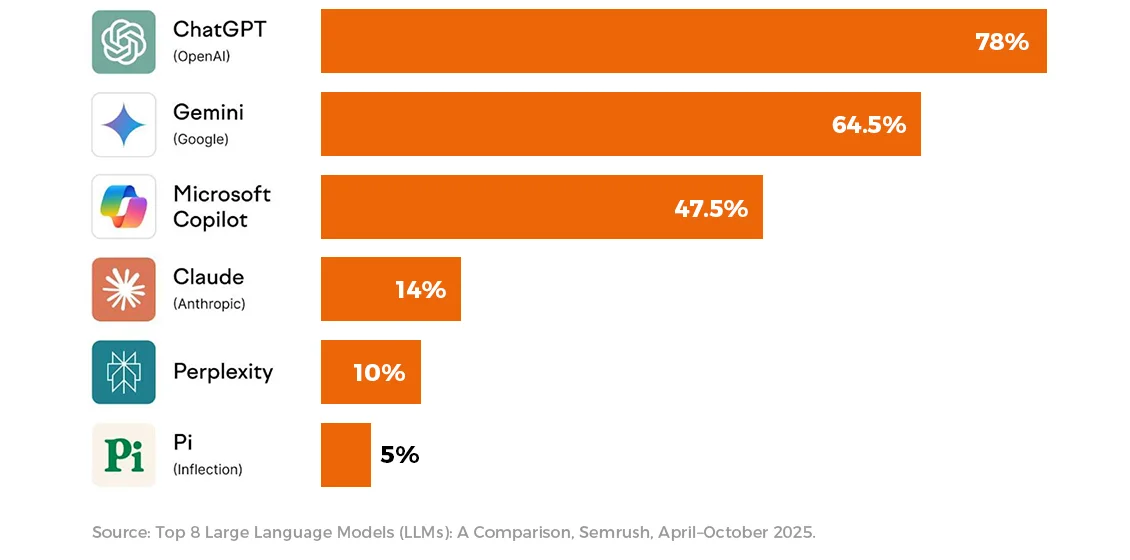
1. ChatGPT (OpenAI): 78%
2. Gemini (Google): 64.5%
3. Microsoft Copilot: 47.5%
4. Claude (Anthropic): 14%
5. Perplexity: 10%
6. Pi (Inflection): 5%
At the same time, the report "How to Rank in AI Search in 2025: 6 Tactics from Industry Experts" by Semrush reveals that by 2028, AI-powered search traffic is expected to exceed traditional search traffic. Over the past 12 months, AI search volume has surged by 1500%, and 63% of consumers have already used AI search at least once.
This shift signals the birth of a new competitive arena: brands must now optimize not only for search engines, but also for AI-generated answers.
What Is GEO?
GEO (Generative Engine Optimization) is a strategy that focuses on optimizing your content and brand signals so that AI engines can easily understand, trust, and cite your information.
Unlike traditional search, AI engines do not simply display ranked web pages. They generate direct answers. GEO is the process of making sure your brand is embedded inside those answers.
In simple terms: SEO helps you rank in search results and GEO helps you become part of the AI's answer.
SEO vs GEO: What Actually Changes?
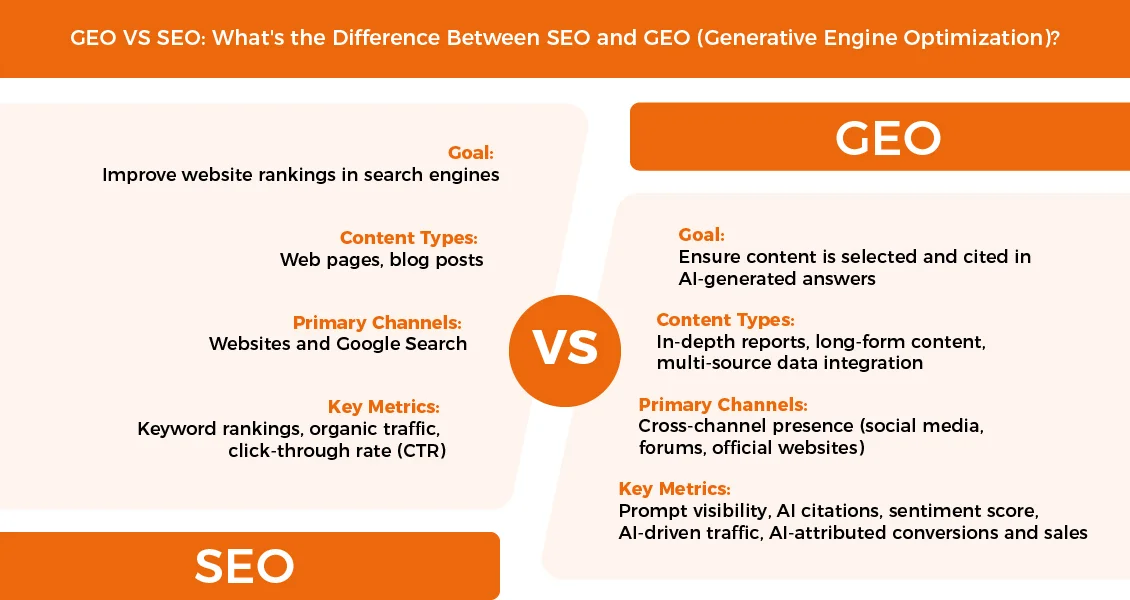
SEO (Search Engine Optimization) is about ranking higher in search engines like Google and Bing to capture organic clicks and conversions on your website. GEO (Generative Engine Optimization), by contrast, focuses on getting cited inside AI-generated answers on platforms such as ChatGPT, Copilot, or Google's AI Overviews.
Both disciplines share a common goal—brand visibility—but they target different "surfaces" and use different success metrics.
Understanding the GEO Pyramid
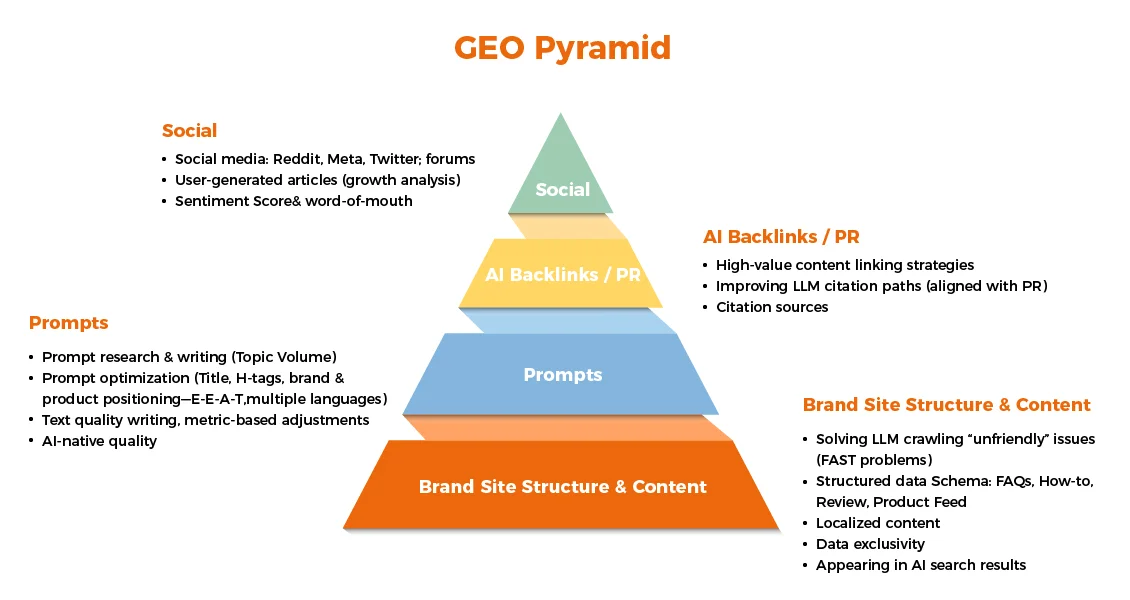
A useful way to understand GEO is through its pyramid structure, which shows how AI trust is built layer by layer.
Foundation: Brand Website Structure & Content
This is the base of the pyramid. It includes clear site architecture, structured FAQs, how-to content, product feeds, reviews, comparisons, localized pages, and data-driven content. AI models rely heavily on well-organized and machine-readable information.
Layer Two: Prompts and Query Logic
This layer focuses on how users interact with AI through questions. It includes topic volume research, prompt structure design, brand–product semantic mapping, content clustering, and building internal knowledge networks that AI models can interpret.
Layer Three: AI Backlinks & Digital PR
This layer is about external authority. High-value backlinks, media mentions, PR coverage, and off-site trust signals increase the likelihood of AI engines treating your brand as credible.
Top Layer: Social Signals
The pyramid is topped by social validation. Reddit discussions, Meta platforms, Twitter/X, community forums, user engagement, and sentiment analysis provide real-world signals that reinforce trust.
Practical GEO Tactics for Independent Brands Independent site owners do not need an entirely new marketing team to start with GEO
Instead, they can layer GEO tactics on top of existing SEO work. Here are practical steps: Turn product expertise into "answer pages" Build in-depth guides around high-intent questions that your ideal customers ask, such as "how to choose a cordless vacuum for small apartments" or "best stroller for frequent travelers."
Each guide should: define the problem, explain key decision criteria, and show where your product fits as one of the solutions, with clear pros, cons, and use cases. Use structured data and clear formatting Implement schema markup (Product, FAQ, HowTo, Organization) so both search engines and AI systems can reliably extract facts such as price range, features, and reviews.
Within the content, use headings, bullet lists, and comparison tables to highlight key attributes that a model might include in a concise answer. Strengthen brand presence across the open web AI systems are trained on more than just your site; they ingest blogs, forums, reviews, and authoritative directories.
Independent brands should encourage credible third-party mentions—guest posts, expert quotes, media coverage, and honest reviews on public platforms—so the brand appears as a recognized entity across multiple sources.
How to Improve Your Brand's AI Visibility?
AI visibility is no longer abstract — it is measurable and optimizable.
Brands can increase visibility by improving their presence inside mainstream LLMs, increasing positive brand mentions, and strengthening rankings for core AI prompts. Improving the accuracy and relevance of AI-generated responses helps raise the proportion of positive mentions within the Top 100 language source materials.
Just as important is competitive intelligence: comparing your brand's performance against key competitors inside AI-generated results helps you optimize your share of voice and uncover strategic gaps.
Final Thoughts: The Future Belongs to Brands That Become the Answer
SEO is not disappearing. It is evolving.
GEO is not replacing SEO — it is becoming the trust layer that sits above it. In the AI search era, visibility alone is not enough. Only brands that are frequently quoted, trusted, and recommended by AI systems will dominate customer attention.
The brands that succeed in the next decade won't just rank — they will become the answer. If you want to explore more insights and information, you can visit the TVCMALL Blog for in-depth articles: https://www.tvcmall.com/blog
Leave a Comment
Your email address will not be published. Required fields are marked *



Stay Current with TVCMALL Wholesale
Subscribe for free to our blog and get expert advice, industry insights, and top wholesale picks. Boost your sales with TVCMALL today!